
Fear
The thin line between normality and catastrophe: Part 2

This is article 6 in the Psyverse #2 series (and article 2 in the Thin line series). For previous articles, see the compendium.
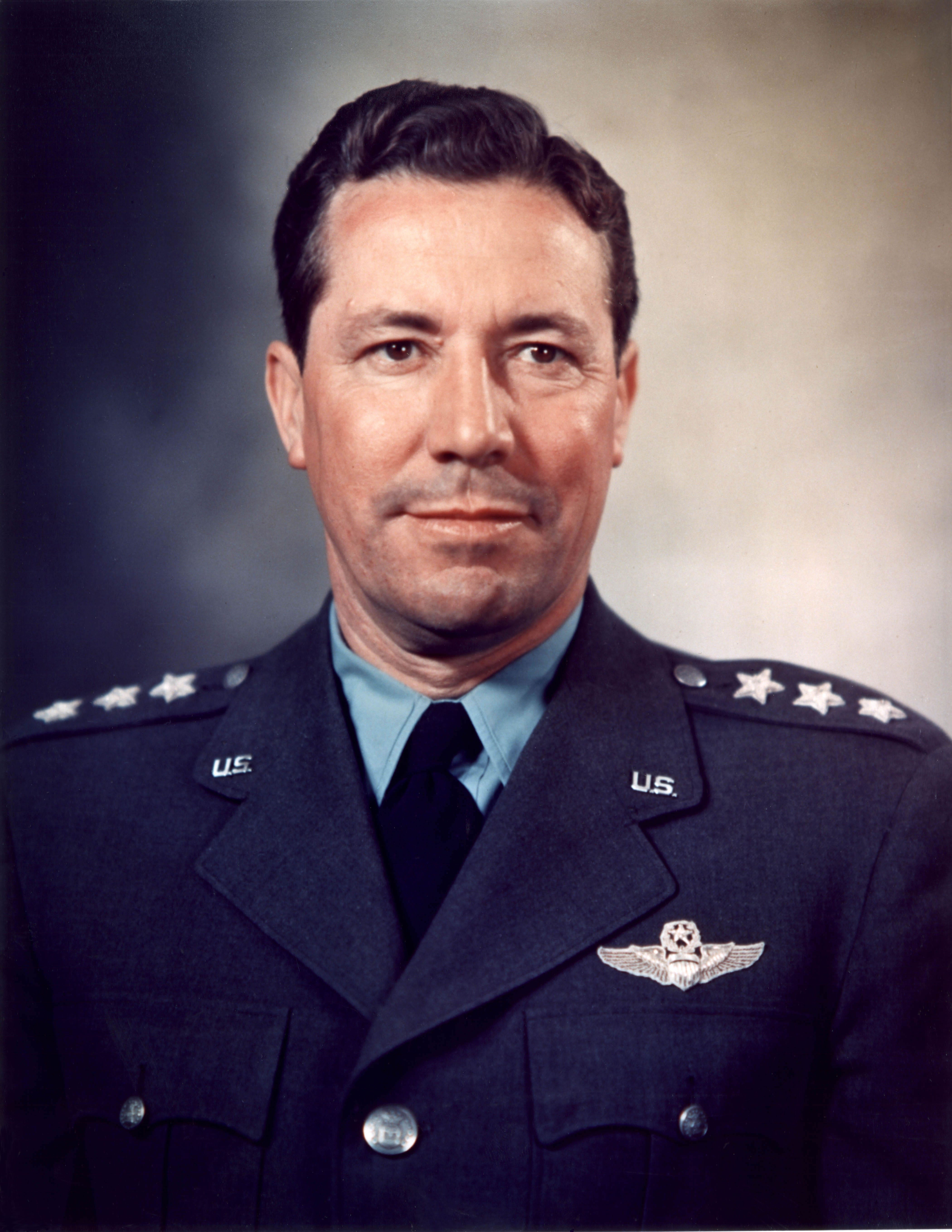
On November 1st 1958,1 General Elwood Richard Quesada became the first Federal Aviation Agency (FAA) administrator at a time when air traffic control was “a dangerous hodgepodge of uncoordinated civil and military operations”.2 Quesada introduced a new program of cooperative military-civilian control of airspace, and instigated a “no nonsense” approach for civil aviation pilots, bringing them up to “military standards”:
[Quesada] sent his inspectors through a demanding Air Force checkout course in the KC-135 (the military version of the Boeing 707), and took the course himself… ‘Now,’ [Quesada] says, ‘the FAA inspectors can fly these jets better than the man they’re checking out.’3
The inspectors picked up on everything, with the FAA jumping on infractions with heavy fines. Quesada justified his actions by saying:
When you go to the ticket counter and buy a ticket…you don’t know who’s going to fly you, or anything about his training, or the airline’s equipment – nothing. The public acts in faith, faith in this system, and we’ll see to backing up that faith. I’m here to represent the public, and dammit, the public will be protected.4
Administrators and pilots reluctantly agreed that this cleanup campaign by Quesada was a good thing, but it came at a cost.
Animosity grew between pilots and the FAA. Pilots felt that the inspectors were overreaching, picking up on questionable minor indiscretions resulting in fines, instead of improving systemic problems.
For example, Quesada seemed to believe greater pilot discipline was the main answer to the near miss problem. On March 3rd, 1959, he sent a letter to Clarence Sayen, the President of the Air Line Pilots Association (ALPA), noting as a passenger, “all too often the pilot is in the cabin talking to passengers or engaging in endeavours not essential to his duties”. He drew attention to a regulation stating that all flight crew members should “remain at their respective stations when the aeroplane is taking off or landing, and while on route except when the absence of one such flight crew member is necessary in connection with his regular duties.”
Sayen, in response, pointed out the impracticalities of Quesada’s request. Under the regulations in force at the time, only the pilot was required to be qualified to operate the specific controls of the aircraft being flown.5 Further, it was the pilot’s responsibility to ensure the passenger cabin was safe,6 and considering some flights were 12 hours long “the sensible pilot gets out of his seat occasionally for exercise… to retain his alertness”. He noted that ALPA had been pushing for a requirement of specific aircraft copilot training for years.7
Sayen noted that FAA inspectors were now timing the pilot’s visits to the passenger cabin, filing violations that were not consistent – the absence times ranged from 7 to 23 minutes. He accused the inspectors of turning Quesada’s letter into a rigid rule through a “childish Gestapo program”.8
The animosity had a particular impact on near miss reporting. According to Joseph Hartranft, president of the Aircraft Owners and Pilots Association (AOPA), when the transfer of safety regulation from the Civil Aeronautics Board (CAB) to the FAA began on 1 January 1959,9 near miss reports previously sent to the CAB were now heading to the FAA – without pilots knowing this had happened.10 When the pilots were eventually informed on March 9 1959, through a press release, it did not mention that pilots no longer had immunity, as that provision only rested with the CAB.
In the six-month period between January and July 1959, pilots were being charged by the FAA with violations based on their own voluntary reports. The pilots, understandably, were not very happy about this, and near miss report submissions dropped off dramatically.
When the CAB near miss program was shut down in July 1959, the FAA took on the responsibility of collecting and analysing near miss reports. Except almost none were now being submitted.11 Senator Engle, in the Review of the Federal Aviation Act Senate hearing in 1960, illustrated the situation:
The FAA invited pilots to report near misses. And so a lot of dumb country pilots like me – and I wasn’t one of them who made the report – reported a near miss; and found himself cited because he was at the wrong altitude or something… I noticed this magazine, the Pilot’s magazine, published by AOPA, just said quit sending in the reports; don’t report or you will get clobbered […]. This is the kind of an attitude that doesn’t contribute to air safety.12
Clarence Sayen asserted that the non-immunity “policy of the FAA is fallacious and should be reversed immediately.”13 It was not reversed.14 It took a new administrator of the FAA, Najeeb Halaby, to reignite a near miss reporting program when he took office on March 3rd, 1961.
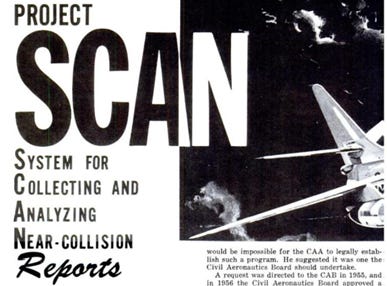
Due to the damage in trust caused by the previous administration, Halaby found that pilots were unwilling to report to the FAA, even with the promise of immunity.15 Therefore, he asked a third party, the nonprofit non-governmental organisation called the Flight Safety Foundation (FSF), to run a near miss reporting program. It was called Project SCAN (System for Collection and Analysis of Near mid-air collision reports) and initially ran for six months starting on July 1st 1961, before being extended to a year, finally concluding on June 30th 1962.16

If a pilot had a near miss, they would send a form to the FSF.17 It was anonymous – even if the pilot signed their name, the form would be destroyed once relevant information had been taken from it. Given the Flight Safety Foundation did not have the power to issue punitive action and did not pass on identifying information of the pilot to the FAA, pilots had immunity. However, similar to the previous Civil Aviation Board program, if the information of the incident came through other means, the voluntary form submission did not grant immunity.
The main difference between Project SCAN and previous programs was, according to a 1961 article in Aerospace Safety Magazine:
Where the analyzed information suggests the need for changes of any kind – changes in procedures, traffic patterns, even aircraft cockpit or instrument design – specific recommendations will be formulated and submitted to the FAA for action.… [T]his is where Project SCAN differs.… [Previous] programs have dealt solely with statistics, the ‘how manys’ instead of the ‘how comes.’ Project SCAN deals with the ‘how comes’ or the ‘whys’ as well as the ‘how manys’
Project SCAN received 2,577 reports during its year in operation and seemed to be popular. Some pilots even returned forms without a near miss, simply to state their approval of the program. Interestingly, the FAA also kept its own near miss reporting program, and pilots only turned in 549 reports over the same period – the anonymity and immunity provisions resulted in 2.5 times more reports.18
At the same time as Project SCAN, a small group of the International Air Transport Association (IATA) airline operators decided to form an information exchange “experiment”.19 Information related to safety reported by pilots under one airline operator would be shared with all the others around the world. Arguably, this was the first International civil aviation incident reporting system.20
During most of the 1960s, however, a U.S. national voluntary near miss and/or incident reporting system seemed to once more become relegated to discussions in safety conferences.21
The main push for a national incident reporting system came from the CAB director of aviation safety, and later director of the National Transportation Safety Board (NTSB),22 Bobby R. Allen. He was particularly interested in the role of the computer in accident prevention. Instead of condensing incident reports down into simple, broadly defined categories (such as pilot error, mechanical deficiencies, inadequate maintenance, etc.), Allen argued for a “bulk look” at the data. He wanted to utilise the memory and data retrieval capabilities of the computer to do a detailed statistical analysis to unpick the complex causes of accidents. And to project potential future causes of accidents through analysis of past trends.23
First, however, Allen needed data to awaken the “sleeping giant” of computational analysis. He needed an incident reporting system. This was the subject of his 1966 talk at the 19th Annual International Air Safety Seminar in Madrid.24
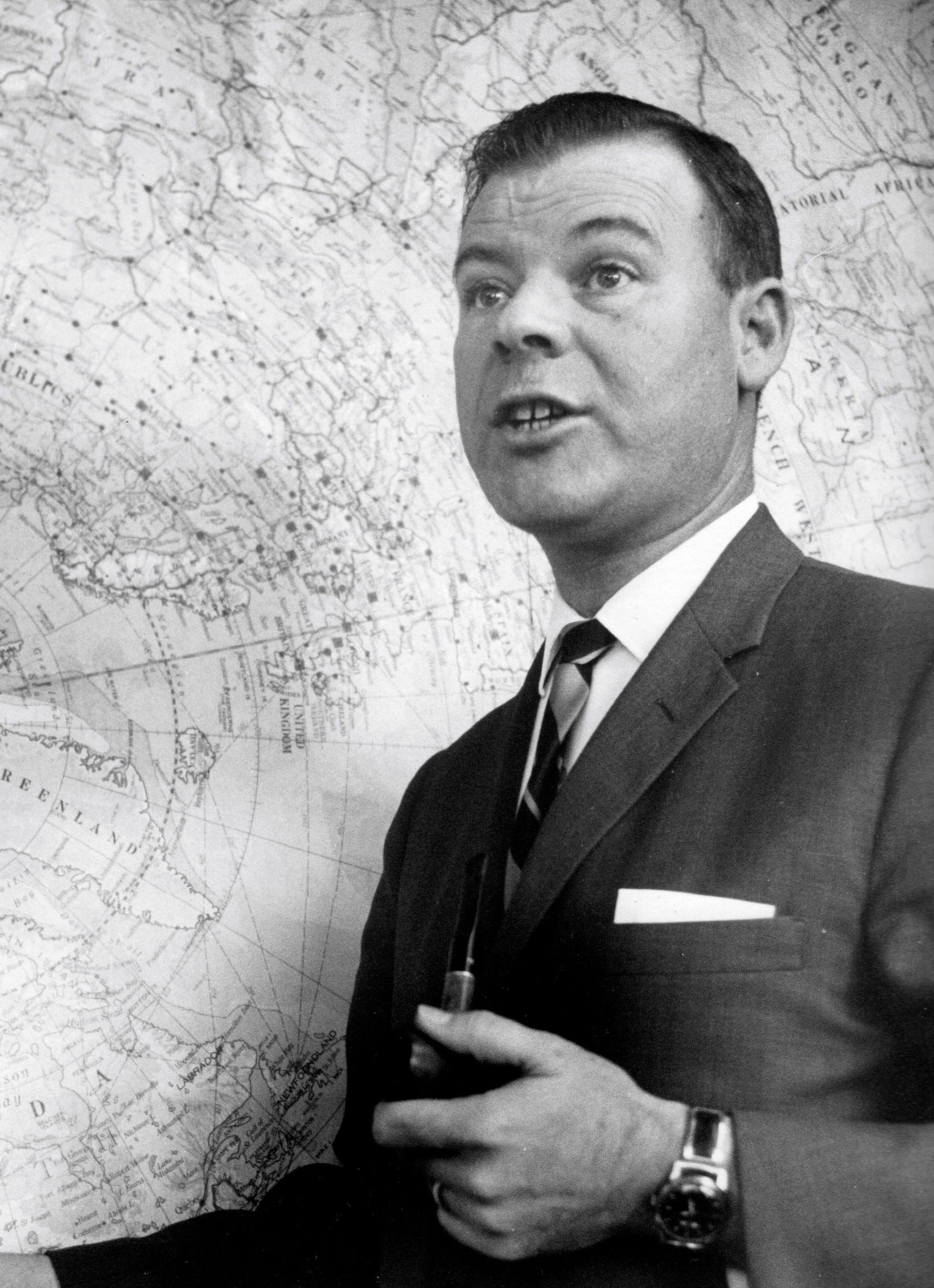

In the talk, Bobby Allen highlighted how the International Air Transport Association information exchange processed incidents, quoting Boyd Ferris, a secretariat at IATA:
[W]e lump incidents and accidents together because the thin line dividing an accident involving fatalities or major damage to the aircraft from an incident in which everyone got off scot free is often nothing more than luck.
Allen then points out that:
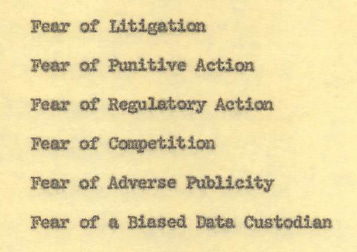
The alarming thing is that we do not take advantage of our good fortune. Here we have a brush with disaster; a live crew and virtually intact aircraft ready to tell a story, and yet we never open the book […]. What is it, then, which stands in the way of communicating this incident information to the appropriate governmental agency for processing? Repeatedly, when this question is asked, one hears the reply – FEAR: fear of litigation; fear of regulation; fear of punitive action.25
In the late 1960s, Allen communicated with officials from the airline industry, as well as associations, to work out how to combat these fears so that an “information exchange program” could be set up.26 He found that the most stubborn fear was litigation.
Several lawyers tried to tackle the fear of litigation.27 Probably the foremost pushing against the fear was a UK lawyer named Harold Caplan, who argued that when an accident occurred, lawsuits would almost certainly follow.28 Since incident reporting would reduce the number of accidents, the number of lawsuits would therefore decrease.29

But fear is not rational. The worry for a lot of airline companies was that the information produced by incident reporting would be used against them in litigation. Caplan therefore proposed example legislation that could be used internationally to protect the exchange of safety information.30 Further, Robert Reed Gray built on an idea by Charles McErlean of United Air Lines, suggesting that liability without fault be imposed on air carriers. Litigation would only be used to decide how much to pay to survivors of victims of accidents – no blame would be asserted.31
According to the archive of Bobby Allen’s letters, significant progress was made towards an information exchange system as the 1960s were coming to a close.32 But Allen found he could not get the project over the line from proposal to implementation. He concluded:
To the question of “Why hasn’t a program been established” everyone immediately trots out the “6 symptoms of the Fear Syndrome” […]. But in the final analysis, I personally believe that the Fear Syndrome is used as an excuse for our failure to overcome the major problem of information exchange. That problem is nothing more than sitting down and writing specifications for the program.33
Allen nearly helped accomplish it. In August 1968, the Air Transport Association of America (ATA)34 and Aeronautical Radio, Incorporated (ARINC) held initial discussions about the establishment of an airline safety data bank to be used for an information exchange program. The ATA then reached out to Allen to try to have the NTSB as the custodian of the data bank, to keep the information safe. By October 1969, potential specifications and requirements for an information exchange program had been written up by ARINC and submitted to the ATA.
On December 3rd 1969, the ATA safety committee met to discuss the ARINC report. Allen’s invitation to the meeting was withdrawn due to fears that a representative of the government in attendance would not lead to a frank exchange of industry views. Subsequently, the ATA decided they:
would not be willing to participate at this time […]. However, the airlines recognize the desirability of a program of accident/incident data analysis and exchange in the airline industry.35
ARINC recommended the ATA continue with an alternative program where the ATA would “select a non-government organization to function as data custodian”. This never came to pass. Bobby Allen died on November 17th 1972. Despite all his efforts, he never saw the creation of an incident reporting system.
For fear to be overcome, the thin line between incident and accident had to visit Washington DC, where legislators could see the consequences of their inaction with their own eyes.
The series within a series continues next Thursday.
If you enjoyed today’s article please👻 AHH! A ghost!! … … Okay, I think the coast is clear… If you 🧟 AHHHH, gosh darn it! … Right, I’m boarding up my house🏚️ .
If you enjoyed today’s article, please consider dropping a heart❤️. If you think someone else would be interested in some aviation history, please do restack 🔄 or share 🔗. It would be much appreciated!
The copilot did not have to be qualified to fly the specific type of aircraft, and the third person in the cockpit did not have to be qualified to fly at all.
Flying an aeroplane is not like driving a car. You cannot just jump between types of aeroplanes and expect to master the controls. Each aeroplane type (e.g. Boeing 737 or Airbus A380) has a different layout of controls and different characteristics (e.g. number of engines and placement, shape of wings, size of aeroplane, etc.)
This was pre 9/11, when pilots were able to visit the passenger cabin.
Page 149 of the Review of the Federal Aviation Act. In the letter, Sayen said:
An occasional trip by the pilot in command to the passenger cabin to carry out his statutory duties is the least of our worries. We have major air safety problems in this entire crew qualification and training area, in the air traffic control area, in the inadequacy of our airports, in providing the pilot in command with adequate tools with which to work including airborne radar, in insuring that the carriers’ training programs are adequate, and in many other major safety areas.
Quesada, in his response, wrote an incredibly long letter. Well, more like a rant really (in my opinion). It is the type of thing you write to your ex, which you know you really shouldn't, but man, you have feelings you need to get out! Then, when you re-read the letter years later, you feel embarrassed while thinking, “Why on earth did I write that?” Note: definitely not something the author did…
Sayen, in a statement, called it “a sad letter”, accusing Quesada of missing the point of the original reply:
The Administrator has completely missed the point of the safety problems raised by the airline pilots. He has attempted to convey to the public that the airline pilot is conducting himself irresponsibly by filing a complaint with the administrator. If Mr. Quesada is to be so thin-skinned, he has rough days ahead.
During the FAA hearing, Senator Engle, in reference to a different letter, also had some advice for Quesada:
I would like to suggest, General, that if you had been in public as long as some of us have, a mean editorial now and then is in due course. You ought to expect it, and ought not to be too thinskinned about it.
Note: this is before the CAB near miss program had been shut down in July 1959.
According to Najeeb Halaby, the second president of the FAA.
See Page 718 of the Survey of Selected Activities (Part 7 - Efficiency and Economy in the Federal Aviation Agency) House of Representatives Hearing in 1962.
The conversation between Senator Engle and Quesada is well worth a read. You can almost feel the tension when Quesada is asking for examples of times the FAA have been abusive, and Engle, quite reasonably, does not give it (so as not to incriminate pilots).
Though there did seem to be a survey in 1960 conducted by the United States Air Force: USAFE’s Near Collision Survey. Source: Page 12, Aerospace Safety magazine, December 1961 edition
Page 719 of the Survey of Selected Activities (Part 7 - Efficiency and Economy in the Federal Aviation Agency) House of Representatives Hearing in 1962.
Halaby is talking about safety complaints, which I am assuming encompasses near misses. Halaby notes:
I will try very hard to convince people that they get a fair and fully respectful attention and action on their complaints, but it is not in human nature to report to the man who has the responsibility for policing infractions of the rule.
According to two articles. Aerospace Safety magazine, in September 1961, published an article on page 7 about Project SCAN (Do not look at the next page in this magazine), saying it was going to last six months. On page 13 of the November 1962 edition of the FAA’s Aviation News, an article was published noting the program went on for a year.
Here is what the form looked like:
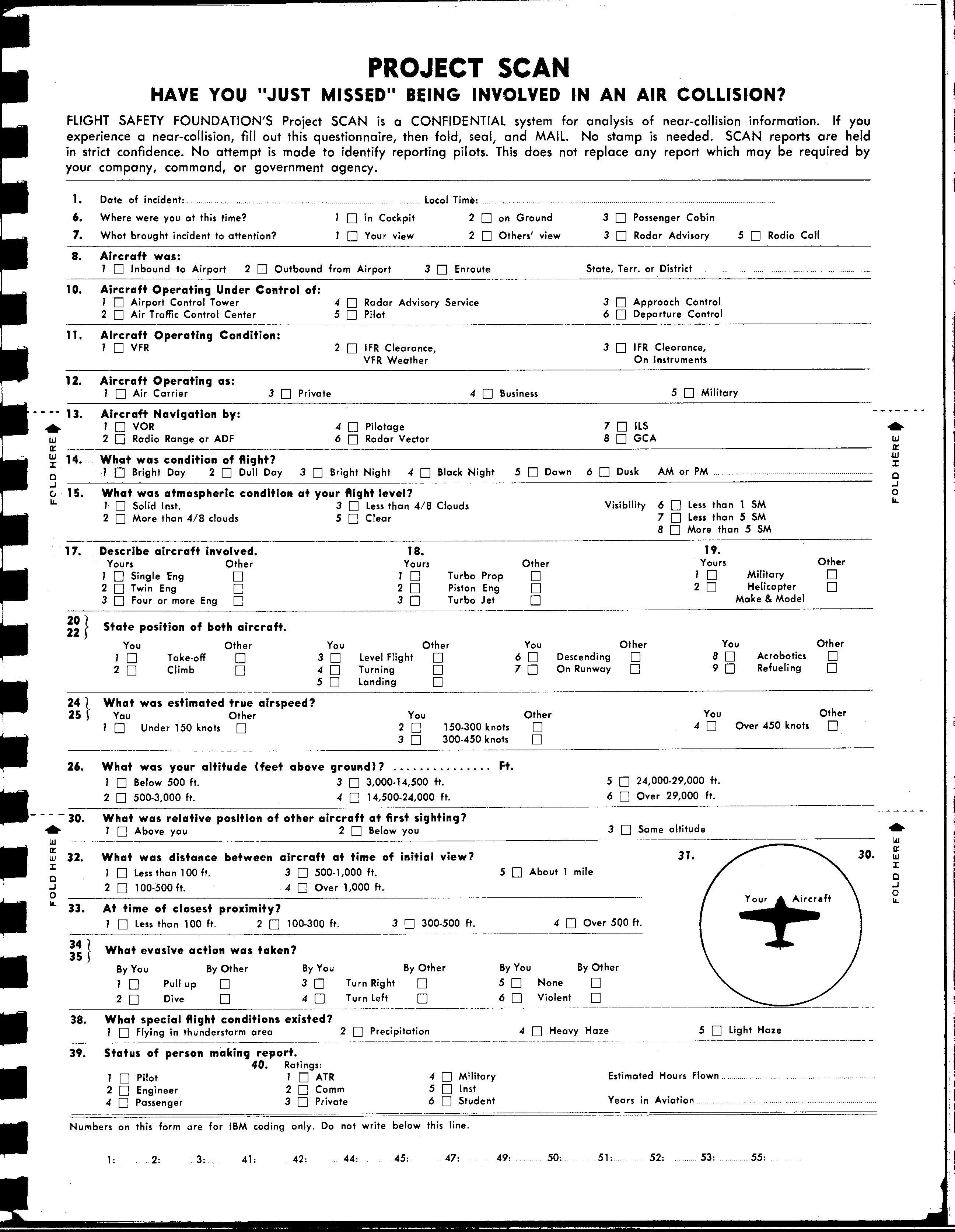
Source for entire paragraph: Page 2, July 1961 edition and Page 13, November 1962 edition of FAA Aviation News.
The final FSF report on project SCAN identified five “major problem areas”: high altitude military and air carrier operations, single-engine jet operating practices, Visual Flight Rule operations, terminal area procedures and radar limitations. The program also brought to light specific issues, such as pilots not adhering to landing patterns. The FAA then worked on finding solutions to these problems. Both the FAA and project SCAN showed that most incidents concerned general aviation (private or recreational transport).
[1] H. Caplan, ‘Need for the Exchange of Safety Information’, J. Air L. & Com., vol. 34, p. 386, 1968.
According to Gordon Burge [2], the Australians had a compulsory reporting system dating back to the 1940s. Though I don’t think it was international, and I don’t know much about the details of the program.
In any case, the IATA experiment was successful. It appears this experiment evolved into the current Incident Data Exchange.
[2] H. K. Gordon-Burge, ‘Practical and Legal Problems of Disseminating Air Safety Information. Part 1. Practical Problems’, The Aeronautical Journal, vol. 71, no. 683, pp. 773–781, Nov. 1967, doi: 10.1017/S0001924000054105.
According to David Thomas, a deputy administrator at the FAA, in a 1967 House of Representatives Hearing, A reporting system did seem to still be in place with the FAA, but it did not contain immunity or anonymity.
I am not sure why a national anonymous near miss reporting program following Project SCAN did not occur. It requires more research on my part.
[3] B.R. Allen, National Transportation Safety Board Bureau of Aviation Safety, 34 J. AIR L. & COM. 399 (1968) https://scholar.smu.edu/jalc/vol34/iss3/10
Incident Investigation - The Sleeping Giant by Bobbie R Allen.
Bobby Allen actually laid out five fears in letters he wrote to officials and members of airlines (pg 44): Fear of litigation, Fear of Punitive Action, Fear of Regulatory action, Fear of Competition, Fear of Adverse Publicity (He added Fear of a Biased Data Custodian later, see pg 40/41, but I can’t find any explanation of what he means)
[1] H. Caplan, ‘Need for the Exchange of Safety Information’, J. Air L. & Com., vol. 34, p. 386, 1968.
[2] H. K. Gordon-Burge, ‘Practical and Legal Problems of Disseminating Air Safety Information. Part 1. Practical Problems’, The Aeronautical Journal, vol. 71, no. 683, pp. 773–781, Nov. 1967, doi: 10.1017/S0001924000054105.
[3] H. Caplan, ‘Practical and Legal Problems of Disseminating Air Safety Information. Part 2. Possible Solutions to some of the Problems’, The Aeronautical Journal, vol. 71, no. 683, pp. 781–786, Nov. 1967, doi: 10.1017/S0001924000054117.
[4] R. R. Gray, ‘The Attorney’s Role in Accident Investigation’, J. Air L. & Com., vol. 34, p. 417, 1968.
Ibid (Source [3])
Bobby Allen, in a letter to Gordon Maxwell (Vice President Ground and fleet operations Pan American World Airlines), writes:
Although I personally beleive the fear of litigation is more notional than substantive, let’s assume for a moment that there is some risk involved when the [information exchange] program is initially started. It will be far better to pay short term increased risk in 1969 dollars, rather than 1979 dollars. Think how much better it would be if we had decided to pay for this program back in 1958.
As we will learn, they paid 1979 dollars.
The SAFEX system - Source [3] (footnote 27)
Source [4] (footnote 27)
Bobby Allen proposed that the NTSB could serve as the data repository in an information exchange program, ensuring that data was handled confidentially. Page 28 of letters.
From pg 40/41 of Bobby Allen letters. “major problem” underlined in original text, bold added by me.
A trade association representing commercial airlines - now called Airlines for America (A4A)